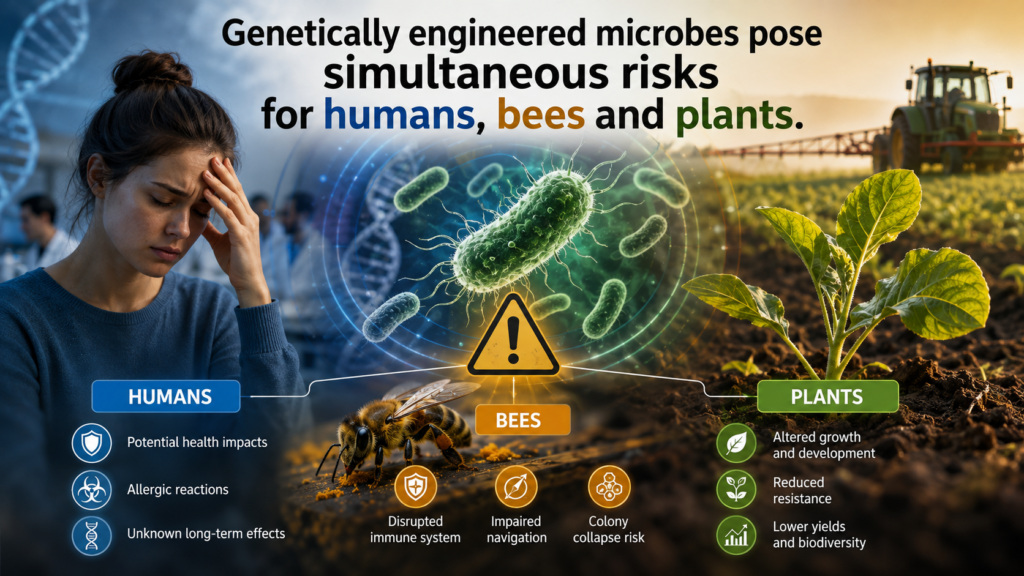
The European Commission is proposing a far-reaching deregulation of environmental releases of genetically engineered microorganisms if, in their natural forms, they are considered as safe. Testbiotech research shows that around 40 species of such microbes are found in honey bees and bee products. Many of them are also are part of the microbioms of soil, plant, animals and humans. If genetically engineered microorganisms that belong to these species are released into the environment, they may easily enter the food and feed chains and may end up in human diets, for example, via bee products. Against this background, lower standards in risk assessment cannot be justified. Microbes obtained from genetic engineering processes can exhibit unique patterns of genetic changes and biological characteristics that are new to the environment, even without the insertion of additional genes. This is because new genetic engineering allows microbial genes and their activity to be changed, blocked, enhanced or suppressed to achieve results far beyond what was possible with previously used methods. The risks, for example, include higher toxin production, higher invasiveness and negative effects on natural microbial communities necessary to maintain the health of plants, animals and humans. The proposed future regulation would allow environmental releases of genetically engineered microbes, even if there were significant data gaps. Furthermore, any potential environmental spread would not be subject to control, and the authorisation would not be restricted to a maximum of ten years, as is currently the case, but would be unlimited after the first renewal. The list of microorganisms considered environmentally safe currently comprises more than 120 species of bacteria, fungi, algae and viruses. The proposal made by the Commission assumes that genetically engineered organisms belonging to these species, can benefit from fast-tracked market approval if no additional ‘genes of concern’ are inserted. However, as the report shows, the risks of genetically engineered microbes does not depend on the insertion of additional genes.
Contact: Christoph Then info@testbiotech.org Tel +49 151 54638040
Further information: https://www.testbiotech.org/publikation/fast-track-releases-of-genetically-engineered-microorganisms-gemos-risks-across-the-domains-of-life/
The Commission proposal: https://eur-lex.europa.eu/legal-content/EN/TXT/?uri=celex:52025PC1031